Compost not heating up? Why a cold compost bin can still work
Compost bin not heating up? Small home bins often stay cold and still make compost. For heat, make it bigger, then fix the moisture, greens or air.
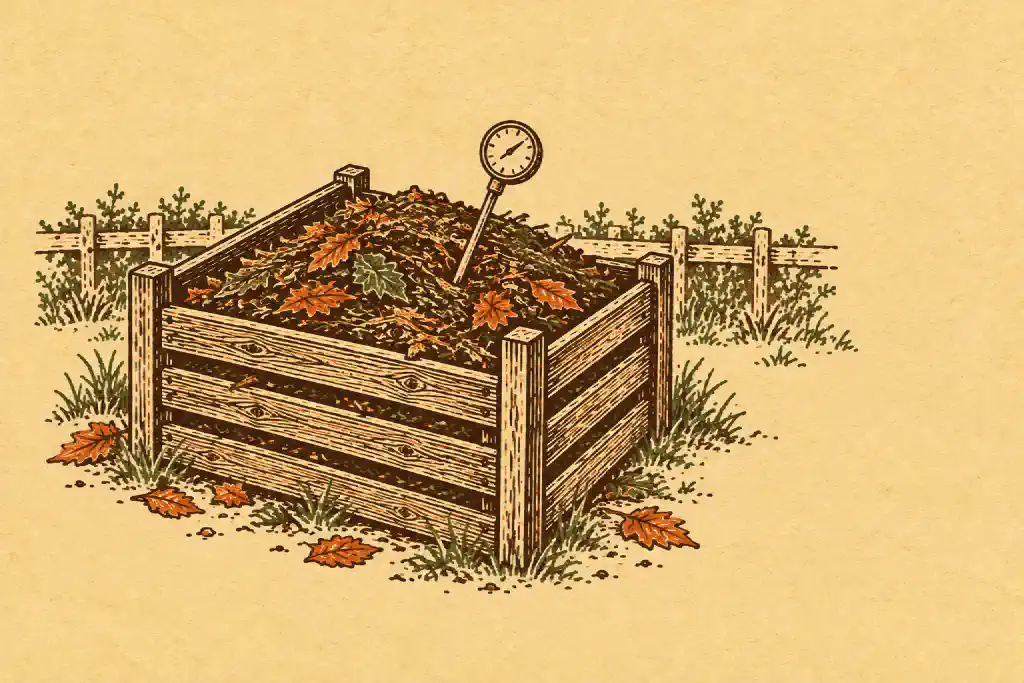
If your compost is not heating up, you’ve probably read that a working pile should feel warm, and yours never has. A lot of composting advice assumes a big, hot pile. In a small home bin, staying cool is common, and it isn’t proof you’re doing it wrong.
Quick fix
- Mid-winter? A cold bin is just resting. See Composting through winter.
- Tumbler that’s wet, in balls or topped up every week? A drum has its own usual causes. See Compost tumbler problems.
- Check the bottom. Open the hatch, or dig down at one side.
- Dark and crumbly, and the level slowly dropping? It’s working cold, so there’s nothing to fix. Keep the mix right with Browns and greens.
- Still looks like what went in, and the level isn’t dropping? That’s a stall, not just a cold bin. See Compost not breaking down. If the bin is new, give it time first.
- Want heat? Start with size. Add in bigger loads, or insulate it (Bulk, below).
- Size is fine? Squeeze a handful from the middle. It should feel like a wrung-out sponge. If it crumbles or drips, see Moisture. If it feels right, see Greens, then Air.
Does compost need to get hot?
No. Heat speeds composting up, but the organisms that do the work keep going in a cool bin. Oregon State University Extension’s guide to slow composting lists what they need: “Microorganisms need air, moisture, temperatures above freezing and patience.” Above freezing is on that list. Hot isn’t.
A small bin is slower, not broken. The UK’s Royal Horticultural Society (RHS) says bins of less than about 35 cubic feet (1 cubic meter) “are generally less efficient than larger ones, but will still make compost successfully, although less rapidly.” How much slower? The same Oregon State guide says a cool pile “can take three to six months or longer, but it requires far less management.” That’s cold composting, and the UK organic gardening charity Garden Organic counts a simple pile and the closed plastic cone bin that UK councils supply (the “dalek”) among its cool methods.
So judge a cold bin by what it does, not how it feels. If it’s slowly sinking, darkening from the bottom up and smells earthy, it’s working. When the bottom looks done, Is my compost ready? shows how to check and take it out.
The catch: weed seeds
Apart from being slower, staying cold has one real catch. Oregon State’s guide warns: “A cold pile does not get hot enough to kill most weed seeds, so keep problem weeds out of the pile.” It adds that plant diseases carried in leaves, or in soil on roots, “can also survive”. Garden Organic says a cool pile “may not destroy weed roots or seeds”. So keep problem weeds (seeding weeds and perennial roots) and diseased plants out, as What not to put in a home compost pile explains.
Still want a warmer, faster bin? Start with why it stays cold.
Why a home bin stays cold
The heat comes from organisms feeding on fresh material, and they need plenty of it. Nick Andrews, a compost expert at Oregon State University Extension, told OSU News that “For a continuous fuel source, microorganisms need at least one-half cubic yard to one cubic yard of fresh organic material.” That’s roughly 0.4 to 0.8 cubic meters.
A small bin fed a countertop bin at a time holds far less fresh material than that, and loses what warmth it makes through its sides. Cold weather slows it further.
How to get compost to heat up
Change one thing at a time: size first, then whatever the squeeze test points to, then air.
Bulk
Add more in one go: yard waste with the scraps, rather than small top-ups. If the bin can’t get any bigger, wrap the outside in a layer of straw, dry leaves or an old blanket. Cornell’s troubleshooting table lists “Pile is too small” as one reason a pile “does not heat up”, and gives the fix “Make pile larger or provide insulation”. Oregon State’s Andrews adds: “Make sure you have a steady source of fresh material.”
Moisture
If a squeezed handful crumbles, it’s too dry. Cornell’s fix is to “Add water while turning the pile”. Water each layer as you turn it in. Water poured over the top of a dry bin just runs off. Compost too dry has the details.
If it drips, mix in dry browns, at least a bucket of browns for every bucket of scraps. Compost too wet takes you through it.
Greens
If the squeeze feels right and the bin is a decent size but still cool, mix in a bucket or two of fresh greens. Browns and greens lists what counts and the rough balance to aim for.
Air
The RHS says wet or compacted material composts “slower as less air is available”, and that turning “adds air, which is necessary for the composting process”. Turning also tends to help a cool bin warm up. How you turn it depends on the bin.
Open piles, closed bins and tumblers
Open pile or slatted bin. Fork it through, bringing the outside into the middle.
Closed plastic cone bin (“dalek”). It’s hard to turn, so work a fork or aerator down through the lid instead. Plastic cone compost bin not working? covers its other usual faults.
Tumbler. Spin it rather than fork it. GrowVeg notes that “Compost tumblers tend to be summer workers”, and that “Unless they’re very well insulated, cold weather prevents them from heating up fully.”
Whether it’s an open pile, a cone bin or a tumbler, only the way you turn it changes. Size, moisture and greens matter in all three.
If that didn’t work
- Tried all four and it’s still cool, but sinking? That’s fine. It’s working cold, and patience is the last step. Is my compost ready? tells you when to harvest it.
- Tried all four and the bottom still looks like what went in? Work through Compost not breaking down.
- Added greens and now it smells sour or of ammonia? Match the smell in Why your compost smells.
- Drum still cold in warm weather? See not breaking down or not heating up in Compost tumbler problems.