Plastic cone (dalek) compost bin not working? Too dry, too wet or slow
Closed plastic cone ("dalek") compost bin not working? It's usually too dry, too wet or just slow. Find out which, make one change and lift the bin off to get the compost out.
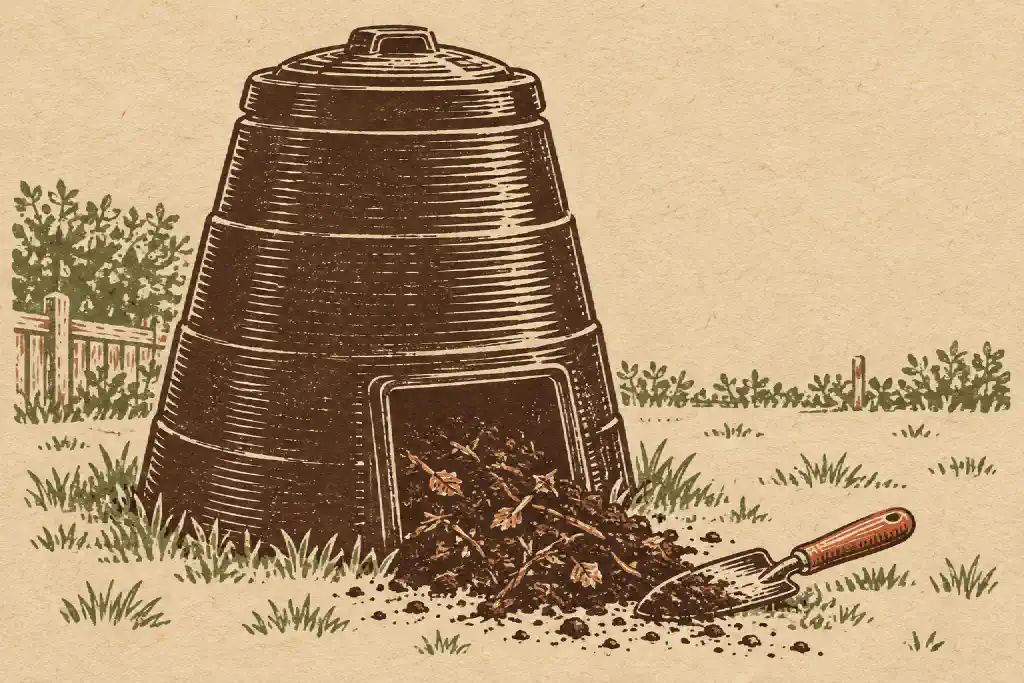
Months of feeding, and your plastic cone compost bin is bone-dry, wet and sticky at the bottom, or so slow you can’t tell if anything’s happening. That’s the closed plastic cone (“beehive”) bin; in the UK, where local councils hand them out, people call it a “dalek” bin. If it isn’t rotting, you’re not lazy. Most advice is written for open piles, and a cone bin fails in its own ways.
Quick fix
- Take two samples: a handful from the middle, dug down through the lid, and one from the bottom, through the hatch.
- Squeeze each. It should feel like a wrung-out sponge.
- Either handful drips, or the bottom is a dense, sticky mass? See Too wet, or a sticky lump at the bottom, even if the top is dry.
- Middle crumbles dry, scraps unchanged? See Bone-dry and nothing has rotted.
- Both feel right, and it’s mid-winter? It’s resting: see Composting through winter.
- Both feel right, bottom dark and crumbly? See Working, just slow.
- Both feel right, but the bottom looks like what went in, or you can’t tell? See Compost not breaking down.
- Just want the compost out? See How to get compost out: lift the bin off.
Do plastic cone compost bins work?
Yes, slowly. The UK organic gardening charity Garden Organic counts the plastic “dalek” bin that UK councils supply among its cool composting methods.
Many home bins never feel warm and still make compost, so judge a cone bin by the level sinking and the compost at the bottom turning dark.
The catch is the lid. It keeps rain out, so nearly all the water comes from what you put in. Feed it mostly dry yard waste and cardboard, and it dries out. Feed it mostly kitchen scraps, and the moisture stays in and drains to the bottom, where wet scraps pack into a dense lump.
How to get compost out: lift the bin off
The UK’s Gloucestershire Wildlife Trust says “some plastic bins have a door at the bottom that the well-rotted material can be removed through with a fork”, and adds: “If this proves difficult, simply lift off the whole bin”.
The hatch is fine for a few scoops. To empty or mix the whole bin, lift it off.
- Lay an old sheet beside the bin. Take the lid off, wiggle the bin loose and lift it straight up. Packed compost can grip the sides, so get help if it sticks.
- Fork the top layer of recognizable scraps onto the sheet, then take the dark, crumbly compost from the bottom.
- Put the bin back (same spot, unless the fix below says to move it) and return the unrotted layer.
Fixing a dry or wet bin? Don’t just dump it back in: follow the rebuild for a dry bin or a wet bin.
Bone-dry and nothing has rotted
Lift it off and rebuild it wetter. The UK’s Royal Horticultural Society (RHS) says compost that is dry and fibrous, with little decomposition, “is usually caused by too little moisture and too much brown material”.
Water poured in through the lid mostly runs past dry material, so rebuild the contents in layers once the bin is off (as above), watering each one. Mix in greens until the mix is back toward two or three parts browns to one part greens. If it keeps drying out, move it into part shade.
For how much water to add, see Compost too dry.
Too wet, or a sticky lump at the bottom
A wet top can be fixed through the lid, but a lump at the bottom means lifting the bin off. The RHS says wet, slimy, smelly compost “may be caused by too little air and too much water”.
If only the top or middle is wet, fork dry browns down through the lid, at least a bucket of browns for every bucket of scraps. Forking can’t reach a bottom lump, so break it up once the bin is off (as above). Mix in at least a bucket of dry browns for every bucket of lump as it goes back in.
The RHS also says “Standing the bin on an earth base provides good access for soil organisms and allows easy drainage.” Put it back on bare soil, not concrete or pavers.
For the full drying-out steps, see Compost too wet.
Working, just slow: how long compost takes in a bin
Cheshire East Council in the UK says that in a home composting bin, the process “is likely to take up to 12 months”. To check whether the bottom is done, see Is my compost ready?.
To nudge it along, lift it off now and then, take the dark compost from the bottom while it’s off, and refill it. That’s how you turn a cone bin.
For a plastic bin with a lid, Scotland’s City of Edinburgh Council says “the heat of the sun can be helpful in speeding up the breakdown process.” If the bin starts drying out in the sun, part shade is better.
Not sure it’s slow rather than stuck? Match what you see in Compost not breaking down.
If that didn’t work
- Made the change and nothing has moved since? Work through Compost not breaking down.
- Smells sour, of rotten eggs or of ammonia? See Why your compost smells.
- Full of pill bugs or slugs? Usually a moisture clue: see bugs in the compost bin. For maggots, see maggots in the compost bin.